Circulation of $NMRT Tokens
The tokenomics of $NMRT is designed to ensure a balance between utility, fair distribution, and long-term price growth. It is targeted both at end users and investors, providing maximum benefits to both categories.
How to Obtain $NMRT
For the Community
Tokens are awarded free of charge in the Telegram MiniApp NameRate as a reward for:
- Initial appraisal of your nickname: on your first visit to the app, you will immediately receive a certain amount of $NMRT for evaluating your Telegram nickname (provided that)
-
New Algorithm - New Rewards
With the release of each new algorithm version, names are reappraised and tokens are awarded again. Previously awarded $NMRT is not deducted. - Voting on other names: gamified mechanics that help us validate the algorithm
-
Help with Nickname Scoring
Today, a mechanism has been implemented that allows you to rate other nicknames (like-dislike) and receive a reward for it. The limit is 10 votes per day. - Completing tasks: this is important for promoting our project
- Your Friends: who join via your referral link
-
Referral Program
The most effective way to immediately receive a lot of $NMRT. Invite friends directly or share your referral link on your social networks.
For Investors
Tokens can be purchased prior to listing as part of two presale waves. Any project participant who applies and is approved in the Whitelist can become an investor.
NameRate Private Sale
Presale is the opportunity to purchase tokens at the best price before market launch. Only Whitelist participants are allowed. We will announce the opening of the Whitelist separately in the app and in our tg community.
Circulation of $NMRT
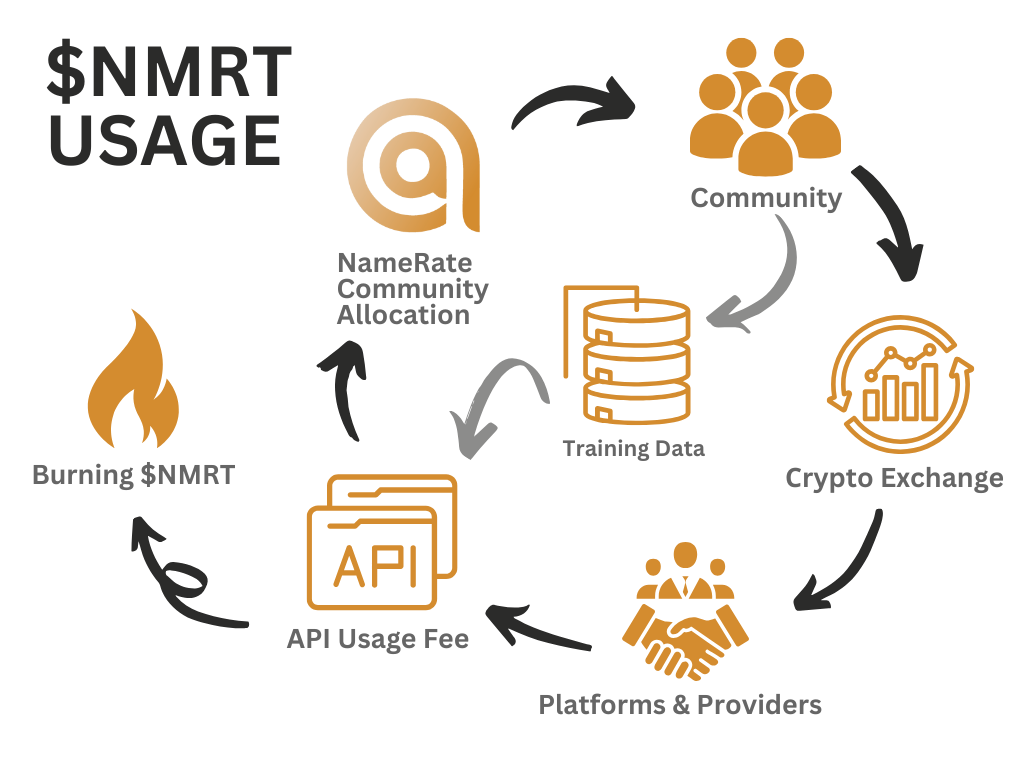
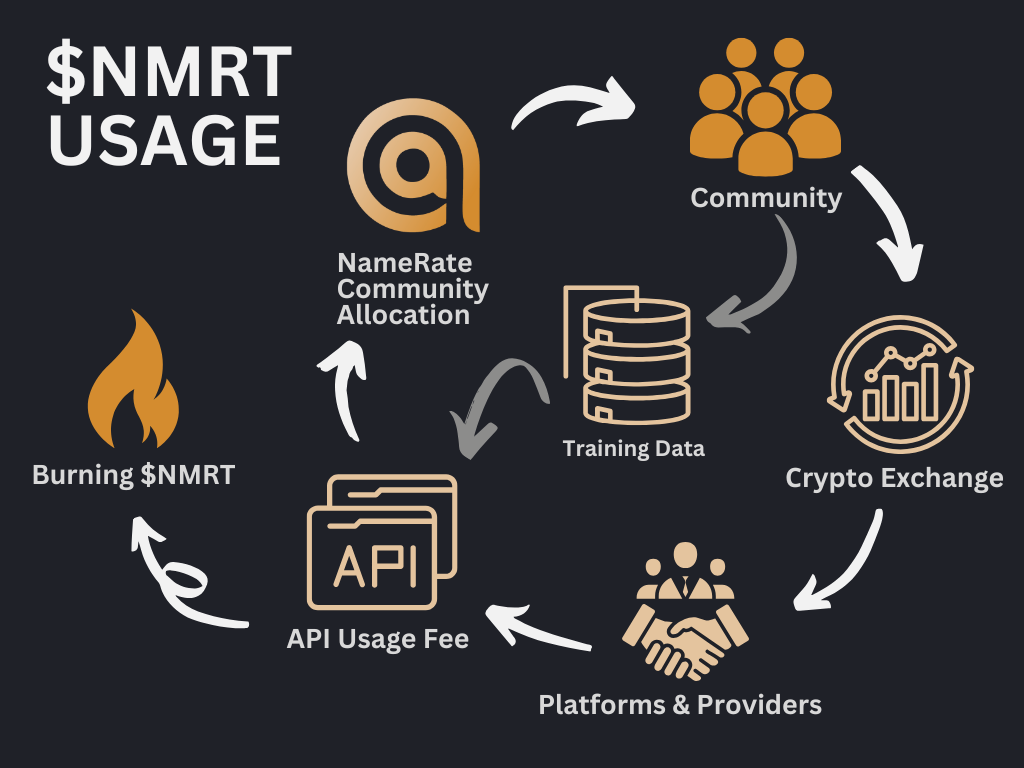
Initially, tokens for the community will be credited according to the $NMRT balances in @NameRateBot. After listing, participants will be able to manage them at their discretion, including withdrawing and trading on an exchange. Tokens used for name tokenization will be spent to cover network fees.
Integrations with external counterparties (TON marketplaces, the core Telegram platform, NFT traders, etc.) are implemented via the NameRate API. Any use of the API entails payment in $NMRT tokens, which market participants can purchase on the exchange. Tokens received for API usage are partially burned and partially returned to circulation as rewards for helping to validate the model.
Stimulating Demand
Any external integration forces the counterparty to purchase the token on the open market, thereby supporting its demand. The burning mechanism is designed to reduce the circulating supply to strengthen the long-term price of $NMRT.
Burning $NMRT
It is intended to stimulate an artificial scarcity. Each burn is announced separately and occurs by sending tokens to a public "dead" (1) address. Only tokens received as fees for usage are burned. The proportion of tokens destroyed will change: at early stages it is 0%, and at later stages - up to 50%.
- A "dead" address is an address with destroyed access keys or an invalid address. Everyone can view the transactions (or their absence), but no one has access.
Other Uses of $NMRT
Asset Tokenization: $NMRT is used to cover (or partially cover) TON fees during the tokenization of nicknames and domains.
Pseudo-Free Operations
In the target solution, $NMRT tokens are automatically exchanged for TON through an internal liquidity pool (1), and then TON is used to pay the network fee.
- The internal liquidity pool is a flexible reserve of a TON-$NMRT token pair in equal monetary value to ensure liquidity for technical exchanges. The token ratio in the internal pool responds to changes in the public pool ratio. The only agent that performs exchanges is the NameRate platform.
Platform Integrations: The $NMRT token can be used in integrations with external platforms within the TON ecosystem (NameRate API).
Staking: After the TGE, staking pools will be created on DEX (Stone.fi), where users can receive enhanced rewards.
Other: This includes payments in $NMRT for promo partners, purchases on the tokenized assets marketplace, and payment of fees for secure p2p transactions. All these initiatives are in the discovery stage and are planned as a secondary phase.